
Lie: I have a right to anything that is accessible to me. | I own things
Truth: Access does not imply that I have a right to it. | I steward things
These words from Dietrich Bonhoeffer shocked me when I first read them.
The call of Jesus teaches us that our relation to the world has been built on an illusion. All the time we thought we had enjoyed a direct relation with men and things. This is what had hindered us from faith and obedience. Now we learn that in the most intimate relationships of life, . . . direct relationships are impossible. Since the coming of Christ, his followers have no more immediate realities of their own, . . . We cannot establish direct contact outside ourselves except through him, through his word, and through our following of him. To think otherwise is to deceive ourselves.[1]
But then I thought that sounded familiar:
For there is one God and one Mediator between God and men, the Man Christ Jesus, — I Timothy 2:5
I am the true vine, and My Father is the vinedresser. . . . Abide in Me, and I in you. As the branch cannot bear fruit of itself, unless it abides in the vine, neither can you, unless you abide in Me. “I am the vine, you are the branches. He who abides in Me, and I in him, bears much fruit; for without Me you can do nothing. — John 15:1,4–5
but, speaking the truth in love, may grow up in all things into Him who is the head — Christ — from whom the whole body, joined and knit together by what every joint supplies, according to the effective working by which every part does its share, causes growth of the body for the edifying of itself in love. — Ephesians 4:15–16
Inherent vs delegated rights
We think we have ‘rights,’ but there’s an important distinction to make: there are two kinds of rights: inherent rights and delegated rights. Let’s define them:
inherent rights – powers or privileges that exist as permanent, essential or innate characteristics. Inherent rights are rights that we have simply by being human.
granted or delegated rights – powers or privileges granted by a legitimate authority.
Inherent rights are just that — intrinsic, innate. And these are the kinds of rights that our Founding Fathers claimed that we had:
We hold these truths to be self-evident that all men are created equal, that they are endowed by their Creator with certain unalienable Rights . . .
‘Unalienable Rights’ are rights that cannot be taken or given away; they are rights that are irrevocable and immutable because they are supposedly granted to men by their Creator, and are ‘built in’ to human beings. The Founding Fathers claimed they were protecting these ‘God-given rights.’
These words are considered sacrosanct by most of the church in America. To question the truth of them is considered anathema — most will not go there. But we have to go there because, although it recognizes the Creator, it does not recognize sin and the bondage that it brought upon man.
These words were principally written by Thomas Jefferson and endorsed by America’s Founding Fathers who clearly believed and taught that liberty is the natural, inherent and inalienable right of every human being. But is that true? What does this really mean? and does this square with the concept of biblical freedom? [2]
We need to be very clear here. It sounds good to be endowed with inherent/unalienable rights, but they simply do not exist — that was the lie. Inherent rights are the very thing that the serpent in the Garden tempted Eve with. They assume that we are free to act independently, and on our own. But this is the lie: LIE: I don’t need God.[3]
The truth is we have no inherent rights; the only rights we have are delegated rights.
But we don’t really think in terms of ‘rights.’ We only think: ‘I’ve got money in my pocket, I want it (whatever it is) and I’m going to buy it (or use it, or take it, etc).’ Our ‘rights’ and our access to things amalgamate and become one thing in our mind.
Rightsaccess.
Access to things
We also apparently have direct access to many things: things that we own: cars, clothes, food, TVs, and things that others own and are made available to us by our willingness to agree to their terms. And now we have access to so many things at one time. Big box stores like Walmart offer an unprecedented, astounding number of items. In 2018 there were 420 million items for sale on walmart.com.[4] That number has only gone up since then. And the ease of digital access is truly unprecedented: Amazon’s ‘Buy Now’ button, anyone?

These two things — rights and access — get tangled up so that it could also read: ‘Because I have access I must therefore have a right to it.’
Today we not only have access to just things, but to knowledge, entertainment, experiences, places, medical care, government services, and all their virtual counterparts. We have access to these things by virtue of certain ‘keys’ we possess. Examples of keys include: money, technology, personal attributes: looks, intelligence, age, heritage, etc. They open and close doors for us. We assume that, because we have these ‘keys,’ we can unlock the door and grab[5] whatever is there. If the government offers us an unemployment check; if Google offers us a world of knowledge; if our job offers us the means to buy a car, a house, or a boat; if our insurance policy offers us ‘affordable’ medical coverage, why not grab it?
But we cannot forget we do not have direct access to things. That cheeseburger you’re about to eat is ONLY there because God, as the Mediator between you and the cheeseburger, made it available to you. Without him you simply would not have a cheeseburger. You may have cooked and assembled its ingredients, but the raw materials — the cow and its milk, and the wheat grain — originated from the Creator. We, of course, know this, but we so easily forget and assume a direct, unmediated access.
Here’s why WE SHOULD NOT GRAB whatever is available to us.
When we grab . . .
We accelerate and acquiesce to the growing avalanche of things — our riches. Many of us are overwhelmed and drowning in things. We have to consciously pull our heads up to see above a sea of things. And yet all this has long been normalized. We cannot imagine any other world — what else could there be?
We’re saying that we can do whatever we want — that God is absent, that our lives are independent of his life — He is nowhere in the equation.
Yet, on the contrary, grabbing what’s available to us quietly undermines our own agency because the build up of things makes it difficult to evaluate anything individually. Our presumption of rational control over things is mysteriously being reversed — things somehow start to control us. The more things we have, the more we slowly become enslaved to our growing mountain of things.[6]
What things am I talking about? Here’s a small sampling of the unprecedented avalanche of things:
| internet ads | kitchen utensils | laundry |
| social media posts | Spotify music playlists | junk mail/email (thousands of emails in our ‘inbox’) |
| various wires and cables | text messages/email | voices/noises |
| trash/disposables | food | odors |
| cheap clothes | ambient lights | notifications, likes, hearts, emojis |
| children’s toys | coffee cups | buttons to push |
| LED lights | digital clocks | traffic |
| background music | house plants | knick-knacks |
| exercise equipment | games | digital apps |
| plastic stuff | streaming services | TV shows/movies |
| various gadgets | songs that won’t get out of our heads | podcasts |
| snacks | tools | jewelry |
| art | photos | furniture |
We covet. By assuming we can just grab whatever is available to us we objectify/idolize that thing. The Tenth Commandment prohibits this.

You shall not covet your neighbor’s house; you shall not covet your neighbor’s wife, nor his male servant, nor his female servant, nor his ox, nor his donkey, nor anything that is your neighbor’s. — Exodus 20:17
The Tenth Commandment is the inverse of the First Commandment. Covetousness is the making of objects into gods; idolatry is the making of God into an object.
Therefore put to death your members which are on the earth: fornication, uncleanness, passion, evil desire, and covetousness, which is idolatry. — Colossians 3:5
We assume we’re mature enough to handle it. Think about it this way: if your 10-year-old daughter found the keys to your gun safe on her desk in her room, should she assume her ‘access’ means she can open it and go hunting? Or what if your nine-year-old son, sitting in the passenger’s seat, sees the keys dangling there in the ignition while you’re pumping gas? Should he move over into the empty driver’s seat and drive away? I think not! Many things are available to us, but some of them (or the accumulated mass of them) could end up destroying us if we’re not ready for it.
We forget God. God sternly warned the Israelites not to forget him when they became rich (the abundance of things with their comfort and ease).
But Jeshurun grew fat and kicked;
You grew fat, you grew thick,
You are obese! . . .
And have forgotten the God who fathered you. — Deuteronomy 32:15–18
and:
Beware that you do not forget the Lord your God by not keeping His commandments, His judgments, and His statutes which I command you today, lest—when you have eaten and are full, and have built beautiful houses and dwell in them; and when your herds and your flocks multiply, and your silver and your gold are multiplied, and all that you have is multiplied; when your heart is lifted up, and you forget the Lord your God who brought you out of the land of Egypt, from the house of bondage. . . . then you say in your heart, ‘My power and the might of my hand have gained me this wealth.’ —Deuteronomy 8:11–20
Riches
We can’t ignore this — riches are dangerous.
Think I’m exaggerating? Read on.
It is easier for a camel to go through the eye of a needle than for a rich man to enter the kingdom of God. — Mark 10:25
. . . But those who desire to be rich fall into temptation and a snare, and into many foolish and harmful lusts which drown men in destruction and perdition. For the love of money is a root of all kinds of evil, for which some have strayed from the faith in their greediness, and pierced themselves through with many sorrows. — I Timothy 6:9–10
Come now, you rich, weep and howl for your miseries that are coming upon you! Your riches are corrupted, and your garments are moth-eaten. Your gold and silver are corroded, and their corrosion will be a witness against you and will eat your flesh like fire. You have heaped up treasure in the last days. Indeed the wages of the laborers who mowed your fields, which you kept back by fraud, cry out; and the cries of the reapers have reached the ears of the Lord of Sabaoth. You have lived on the earth in pleasure and luxury; you have fattened your hearts as in a day of slaughter. You have condemned, you have murdered the just; he does not resist you. — James 5:1–6
The scriptures are filled with warnings and admonitions to the rich.
Newsflash! — most of us in America and the western world are rich, and not only by the world’s standards, but by historical standards. Much of the today’s middle class rates right up there with the ancient nobility and aristocracy.
What does it mean when we assume to have an unalienable, God-given right to anything that is accessible to us? And imagine that we have access to MANY things (which we do). This is an equation of riches/richness — of being rich!
rights + access = riches
OR:
inherent rights + abundant access = dangerous riches
Perhaps this is all so obvious, or perhaps this truth is so embedded and ubiquitous that it’s become perfectly acceptable; or perhaps it’s so acceptable because it appears to be impossible to change. Or perhaps it’s all of the above. And full disclosure: I myself am entangled in this lie. This lie: I OWN things.
We presume that, because we’ve grown up in a technological world, full of strange and wonderful things which are apparently ‘accessible’ to us, but which we hardly understand, that we can simply help ourselves. You may think that the ‘keys’ of your money, your job, your computer access, will take you anywhere. So what am I saying? I’m saying that we must be trained, qualified and approved to use everything. We should not use something, simply because we can! We only have the privilege, the honor and the stewardship of that which our Father approves us to handle, and no more.

So, for example, when we turn on the computer, something that nearly all of us have access to, we should not let that heady experience fool us into thinking we can go anywhere, or do anything with it.[7] Or, simply because we may understand books and concepts more easily, that does not automatically give us the right to read any book or explore any subject we choose. We must let the Holy Spirit filter what we see. When we go to the grocery, we need to let the Spirit cross out items on our list; when we seek a job, when we watch TV (if we watch it), we must first commit our life to the Father and seek first his kingdom and be content to let all of our material needs be added to us.
Riches remedy
What does it practically mean that we don’t have direct access to things? How can we be delivered from the tyranny of things? How can we reject our supposed role of owner and take on the true role of steward?
The remedy for our dilemma is not simplicity, although simplicity is likely to be a result of our attention to this. The remedy is to hear and obey the voice of the Lord. We are a steward and stewards recognize, know and obey their masters. This obedience is a process of radical generosity, and generosity that is taking the heart of our Lord who had compassion on the multitude.
Then one from the crowd said to Him, “Teacher, tell my brother to divide the inheritance with me.” But He said to him, “Man, who made Me a judge or an arbitrator over you?” And He said to them, “Take heed and beware of covetousness, for one’s life does not consist in the abundance of the things he possesses.”
Then He spoke a parable to them, saying: “The ground of a certain rich man yielded plentifully. And he thought within himself, saying, ‘What shall I do, since I have no room to store my crops?’ So he said, ‘I will do this: I will pull down my barns and build greater, and there I will store all my crops and my goods. And I will say to my soul, “Soul, you have many goods laid up for many years; take your ease; eat, drink, and be merry.” ’But God said to him, ‘Fool! This night your soul will be required of you; then whose will those things be which you have provided?’ — Luke 12:13–20
Good question, huh?
I offer the steps below as one way to deal with this lie. If you use this, take each step deliberately, prayerfully, and carefully. And the cycle should be repeated over time.
- Inventory and scrutinize each thing. Perhaps take one room at a time.
- Donate, share or purge whatever you cannot in good conscience thank God for: clothes, activities, notifications, apps, habits, etc. Be boldly compassionate and generous toward those in need. This is the key that desacralizes Mammon.
- Give thanks for everything that remains.
- Remain vigilant.
Don’t be deceived by the siren song of a thousand things that promise happiness and fulfillment. Our Father knows exactly what we need and he is faithful to make every provision for us, in his time and in his way.
[print-me]
[1] Bonhoeffer, Dietrich, The Cost of Discipleship, pg 108.
[2] For more on why we do not have inherent rights, see my article, LIE: Freedom is the right to make my own choices, part 1.
[3] See also my article: LIE: We are not slaves, we are free.
[4] https://expandedramblings.com/index.php/walmart-statistics/ captured on 19 October 2025.
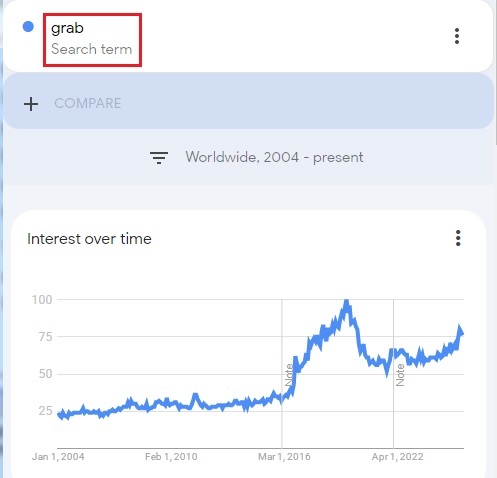
[5] Our use of the word grab is now so common and may reveal a rapacious heart. The definition of grab – ‘to grasp or seize suddenly and roughly,’ shows an impulsive, unthinking action, which reveals a presumption of ‘inherent rights.’ Here is how the search term ‘grab’ has trended since 2004.
[6] See also my article, LIE: More is better.
[7] See my articles: LIE: Passive use of the internet is harmless, part 1, part 2, and part 3.